

Institutional Arrangement
Institutional Arrangement
Kenya's REDD+ programme is anchored in a robust institutional framework designed to ensure transparency, inclusivity, and effective coordination. At its core, the arrangement brings together government ministries, independent commissions, Indigenous Peoples and Local Communities (IPLCs), civil society, private sector actors, and international partners.
The framework is structured around a Supervisory Board, Steering Committee, Coordination Unit, and specialized Thematic Working Groups, all working collaboratively to guide policy, mobilize resources, and monitor progress.
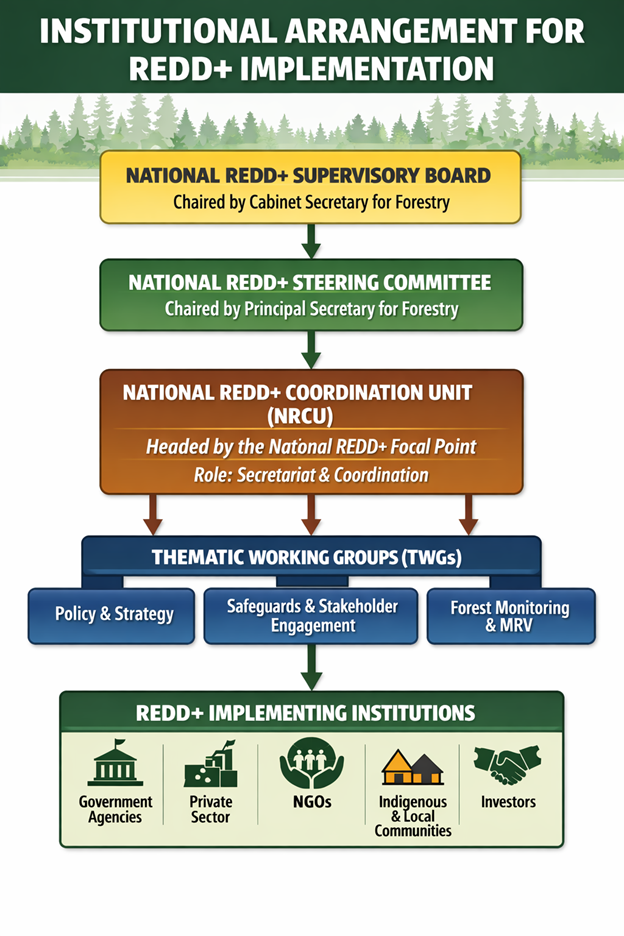
- Established by the Cabinet Secretary in charge of Forestry.
- Comprises representatives from ministries with climate-related mandates, the Council of Governors, Independent Commissions (KNCHR, NLC, NGEC, EACC), Indigenous Peoples and Local Communities (IPLCs), private sector, and civil society.
- Functions as the apex body for policy coordination, harmonization, and advisory services.
- Chaired by the Cabinet Secretary responsible for Forestry.
- Provides guidance on REDD+ implementation, ensuring multi-stakeholder involvement and integration with national development priorities.
- Convened by the Principal Secretary in charge of Forestry.
- Includes representatives from ministries of Climate Change, Energy, Planning, Finance, and Agriculture.
- Membership also includes Chief Officers of KFS, KEFRI, NEMA, Council of Governors, international conservation agencies, private sector actors, NGOs, community groups (IPLCs, NACOFA), universities, UNDP, UNEP, FAO, and the Forest Sector Donor Coordination Group.
- Responsible for designing policies, standards, and instruments for REDD+ implementation.
- Ensures REDD+ integration into national planning processes and mobilization of resources.
- Located within the Directorate of Forest Conservation and is headed by the National REDD+ Focal Point.
- Acts as the Secretariat to the Supervisory Board and Steering Committee.
- Coordinates the National Technical Committee on REDD+.
- Convenes meetings of Thematic Working Groups.
- Oversees generation and dissemination of forestry data to inform sectoral actions.
Technical experts from government institutions, civil society, indigenous communities, and academia provide specialized input. Proposed TWGs include:
These groups provide technical leadership, advice, and support for programme design and implementation.
- Government agencies
- Private sector actors
- Local and international NGOs
- Community groups
- Investors participating in REDD+ projects
Their representation is ensured within the National Steering Committee, reinforcing inclusivity and collaboration.